
Ashwell Prison was not always a prison. The known history of the area begins in the Second World War, when in February 1944, the American forces landed on English soil to train for the D-Day landings in Normandy, which took place on June 6th, 1944. The division was known as the Airborne. They were a parachute regiment trained to parachute into the heart of the conflict. Close to the site was an airfield, and this was where the 505, 507, and 508 trained for the jump over Normandy. The site remained property of the military and likely continued to be used for training until 1955, when it was requisitioned as an open prison for men. Then, with the influx of prisoners, the need for further security became urgent for the safety of the inmates and the staff, leading to its conversion to a category C prison in 1987. In 2003, the prison featured in the news when inmates rioted, barricading themselves in one of the wings and causing thousands of pounds of damage. It is doubtless to say that it was part of the reason in 2008 to build a new six-million-pound wing with an additional 64 cells. However, a further riot broke out in April 2009, when an inmate threatened staff, refusing to return to his cell. Goaded by his recklessness, four hundred other inmates began destroying the prison. The operation to regain control became known as Operation Tornado. Extensive damage had been caused, and a drastic rethink of the overcrowded prison systems led to category B prisoners being downgraded so they could be moved to category C prisons. In 2011, the prison was finally closed as it was deemed too old and insecure to deal with prisoners.
What stories linger behind these walls? My interest in this location was driven by a desire to reach back into the Second World War history woven into Ashwell’s foundations. Who still walks these corridors—prisoners from more recent times, or perhaps shadows from the days when American paratroopers trained for the largest invasion in history? Given its more recent past compared to my team’s usual haunts, I was especially curious to see whose presence would make itself known, and whether we could cross-reference any evidence to build a clearer picture of exactly who—or what—we made contact with. This investigation became our way of seeking answers to those questions.
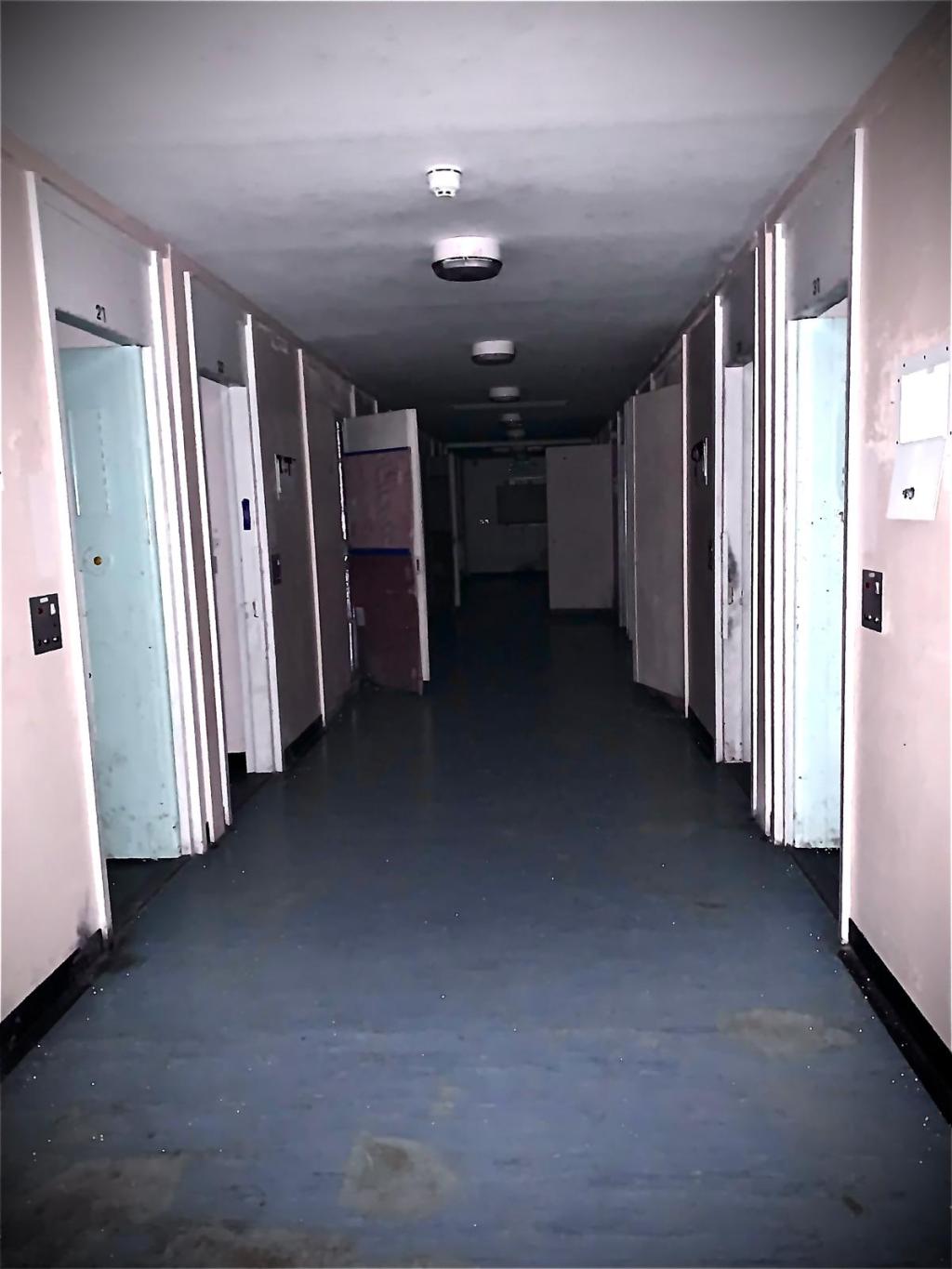
Our investigation began with the usual walk around to familiarise ourselves with the labyrinth of corridors and rooms; although, it didn’t help much as every passage, every staircase, and every room was designed to look the same to confuse any prisoner attempting to escape. I can say it was a system that worked. Whilst on the walk around, I could feel a negative, oppressive energy, seemingly squeezing my lungs, like the air was thick to breathe. It was a dominant presence felt throughout the wings, leading me to believe it was residual energy seeping from the walls.
After our walk around the buildings, we went straight into a watch-and-wait vigil to analyse the activity at the start of the night. Along an upstairs corridor in cell block C, in one group, we set up our trigger objects and began calling for responses. The only activity of note on any of our recording equipment was the TADs (Thermal Anomaly Detectors), which indicated a decrease in temperature. As interesting as this was, I do not believe this activity to be paranormal, as people had recently been moving, causing a draft, and the buildings were naturally very cold and draughty. It is likely the TADS were just detecting the cold air flow. We continued to see if anything more compelling would present itself, and thankfully, it did. It started with hearing knocks, although none of us could quite make out where they were coming from, and then there was the voice! The voice was not heard by everyone, but by those who did, they immediately turned on torches and searched the upper-floor corridors for someone who might have broken in. They could not find anyone. I later heard what sounded like a moan coming from the same direction. There was no conclusive evidence afterward to support what we thought we were experiencing, so we ended the first vigil there.
We headed downstairs, still within C block, to conduct an Ouija board session. The activity on the board started quickly, but we soon learnt the spirit either struggled to spell or refused to answer our questions. From this Ouija session, we learnt that they were a male prisoner, and that they gave us the year 1960 as a possible year of their imprisonment. I found myself inspired by this prisoner’s lack of forthrightness and asked the spirit to tell us what he wanted to say. It was then that the planchette moved to spell ‘burn’. We thought that meant common prison slang for asking for a cigarette. Our attention then was distracted by the sound of someone whistling at the end of the corridor close to us, and we all knew nobody was down there. It was clear, precise whistling, like someone was walking around whilst whistling merrily. The hairs on the back of my neck were all raised. It was some of the clearest, loudest whistling and moving sounds I have ever heard. I did have a look down there with my torch on, and there was no one there.
After leaving that area, we made our way over to block B and to the upper floor. We began in the corridor with a table-tipping experiment, using a few trigger objects placed around us as a secondary aid. As hard as we tried, the table remained still in the corridor, but in the doorway of the cell to our left, the K2 we had placed on the floor there was detecting a very strong presence, which shouldn’t be happening in a building with no electrics. It felt as if there was a spirit standing there watching us around the table. With how responsive the K2 was, we quickly moved the table into the cell and repeated the experiment. In the cell, I immediately felt an oppressive sickness, the same as I described earlier on the walk around, and I also felt dizzy. I asked a few of the others in the cell, and they reported feeling the same. Now that we were in the cell, the K2 stopped flashing, which made it even more compelling. After much persuasion and driving the energy forward, the table started to creak loudly and very slowly rock, but it did no more. We had spent a good half an hour or so for just this little bit of activity, which just goes to show that it’s rarely like what you see on TV, with a spirit seemingly waiting to jump out from around every corner. As a professional investigation team, we work hard and are prepared to wait for that one little bit we can produce for you as the best evidence we can provide, to the best of our knowledge.
We said goodbye to the rest of the group, and the two of us went off on our own for a while to do some experiments in a corner of C block where we had heard the whistling earlier. We set up a static night vision camera, MEL REM, a music box, K2 metres, flashing cat balls, a laser pen, and EVP recorders in separate prison cells. After not much time, we noticed the laser pen starting to flicker, which it shouldn’t be able to do. I had charged every piece of equipment beforehand, so a low battery shouldn’t be the cause. Was a spirit draining the power from the laser pen to give itself more energy? I do wonder. Whilst they were recording, we began with an Ouija board in cell two. We kept calling out, and the planchette did move across the board; however, it was not very forthcoming in response to questions, giving us little more than that it was a prisoner, forty-six years old, who had been imprisoned for six years, and that we were in their cell. As we had little information about who they were, we changed tactics to see if they would show themselves on camera, and where and when. We did get an answer telling us cell four. We headed to that cell and started taking photos, but on later review, nothing out of the ordinary appeared in any of them. After we left the cell and started packing up our equipment to investigate another part of the prison, we noticed the laser pen was almost out. For the rest of the time we had for this vigil, we decided to walk the blocks, doing photography to see if we could capture any of the spirits people have reportedly witnessed. We sadly did not capture anything unusual on camera.
We moved into the last vigil of the night. We really did save the best till last! In cell block A, we conducted an Estes method. If you are unfamiliar with the Estes method, I will give a brief explanation. The Estes method was developed from radio frequencies, as throughout the history of radio, people had heard voices they couldn’t understand amid the white noise. Researchers developed a radio that rapidly sweeps through radio stations and white noise in reverse, in the hope of capturing more of these voices. Paranormal investigators further developed this tool by making the listener wear noise-cancelling headphones so others who weren’t listening to the radio could ask questions without the listener knowing what was being asked. If a response came through, they just had to shout it out, and we would see if it matched our questions. We tried the Estes experiment with a female in the group and got little, so we swapped to a male who volunteered. Straight away, in a deep voice, he shouted ‘hello.’ So we began with our questions, and the responses just kept coming, saying things like broken chords, the lights, happening now, and eventually giving us the name Jack. At times, it seemed he wasn’t talking to anyone but was in distress and breaking down. But from the responses we were getting, a picture was starting to build of who Jack was. We believed he was an American WW2 paratrooper in the 82nd Airborne Division who was positioned here in 1944 for the D-Day landings on June 6th. From the sounds of it, he had died in the jump over Normandy from perhaps a failed parachute, and he did not realise he was dead. It sounded to us as if he was still in that moment in great distress and panic. I tried to be a comfort to him and tell him that the war was over and we had won, but whether that helped, I don’t know. So far, the picture we had built was purely based on what we thought from the brief snippets of words coming through the radio. When we took the headphones off the person listening to the radio, who was completely oblivious to what we had asked, he said he kept hearing the saying ‘gee whizz’ and that he could hear an American accent. He said he didn’t want to shout out gee whizz because he felt silly saying it. This was absolutely incredible support to the picture we had just built up. By far the best Estes experiment I had been a part of. Whilst all this had been happening, we were perplexed when we saw a load of the pellets that were scattered all over the floor from the airsoft that takes place in the daytime move seemingly by themselves. We were all still, and none of us had moved to accidentally kick the pellets, and it certainly wasn’t a breeze. We also had another investigator, who had been on the ground floor by himself, suddenly come running up the stairs, holding an old latch or hinge in his hand, quite clearly upset, saying he had just had it thrown at him and it had hit him on the head! With all this happening, the time had flown, and it was rapidly approaching dawn and time to pack up for the night.
It had felt quite an unusual investigation walking around buildings which felt quite modern and had only closed just over ten years ago. The newer wings certainly looked more like a hospital with their clean beige brickwork and the large double-glazed PVC windows. Not the usual prison I was used to, and certainly not one you would expect this level of activity that I had witnessed, as well as countless others. I also feel it had been a fairly quiet night; the energy in that place was palpable. As I had said earlier, I had set out to try and make contact with the WW2 history, and although we had an unbelievable experience towards the end, I think its longer years as a prison has blanketed over much of the Second World War history, but this is an evaluation made from just one investigation. I am open to being proven wrong and would love nothing more than to find that on other nights, the Second World War history dominated. So, like many locations, it has built a strong picture for a second investigation.
 Phantom Echoes Paranormal
Leave a comment